Receive first-hand news on the latest bond issues, credit updates and special events when you join us on our Telegram channel at https://t.me/bondsupermart!
Highlight:
- Bank of East Asia relied on its interest income which could be able to benefit from the interest-hike cycle, with net interest margin climbing from 1.4% in 1H2022 to 2.0% in 2H2023. Given that the interest rates for HK/US are expected to remain higher for longer, we believe the Bank of East Asia could continue to benefit from the rising rate environment to further improve its profitability.
- In terms of credit quality, the CET1 ratio stood at 16.8% ending on 30 June 2023, which is well above the regulatory requirement and one of the highest levels in the banking segment. The bank's exposure to Chinese property developers was pretty significant for a long time, but with the ongoing reduction in loans, asset quality is expected to improve and the overall credit profile remains excellent.
- Investors may give priority to senior unsecured bonds, with a yield to maturity of nearly 7% for the 2027 USD bond, which is attractive among bank bonds. Investors with higher risk tolerance may also consider its Tier 2 subordinated bonds for yield pickup but should be aware of the associated investment risks.
Recently we highlighted some bank investment choices, including
large global banks such as HSBC and Standard Chartered. There are some
treasures in Hong Kong's banking sector, and their bond yields are usually more
attractive than those of Standard Chartered and HSBC given the similar
investment risk level. In this Idea of
the Week, we are going to turn our attention to the Bank of East Asia
("BEA").
Company Background
Founded in Hong Kong in 1918, BEA is now listed on the Hong Kong Exchange with the stock code 23.HK. The current market capitalization reaches HKD 25.0 billion. From the ownership structure's perspective, Sumitomo Mitsui Banking Corp (SMBC), the one of top 3 banks in Japan is the largest shareholder with a share of 21.6%. Criteria, a large-sized financial institution in Spain owns around 19% share of BEA, making it the second-largest shareholder.
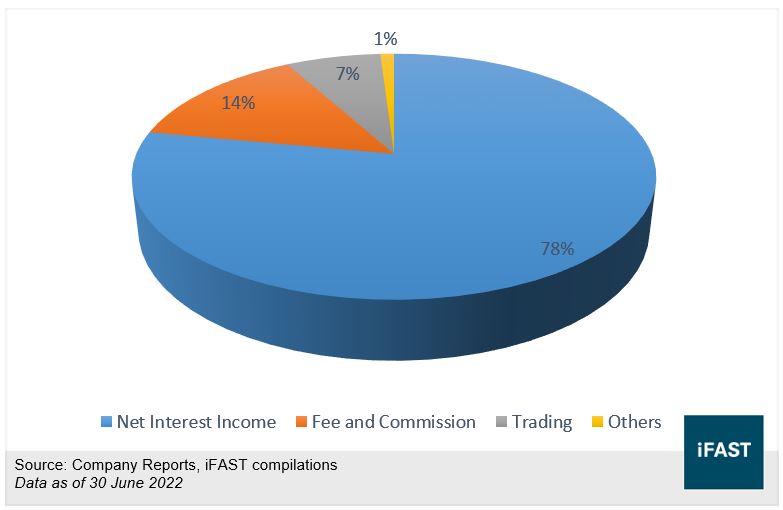
BEA's core business comprises personal deposit, personal borrowing, corporate financing, and asset management. Looking into the revenue breakdown, BEA is a traditional bank, with over 80% of total revenue coming from interest income (Chart 1).
Chart 1: Revenue Breakdown
 BEA is the sixth-largest bank in Hong Kong in terms of total
assets. Apart from the business in Hong Kong, BEA also has a large exposure to
the Chinese market. The bank has operations in over 40 cities in China, ranking
it among the top foreign banks.
BEA is the sixth-largest bank in Hong Kong in terms of total
assets. Apart from the business in Hong Kong, BEA also has a large exposure to
the Chinese market. The bank has operations in over 40 cities in China, ranking
it among the top foreign banks.
Operation Highlights
Full-scale Improvement in Profitability Owing to the Rising-interest Environment
In general, the interest hike cycle is favorable to banks' interest income but has downside pressure on non-interest income. It's undoubted that BEA's interest income-oriented business benefits much from the rising interest environment, with all profitability indicators seeing an improvement. From Table 1, despite the weak performance of non-interest income with a contraction on commission and trading fees, the interest income in 1H2023 surged by 38.1% to HKD 8.1 billion, and total income also saw a 26.6% increase from one year ago.
Under a rising interest environment, the net interest margin moved up from 1.4% in 1H2022 to 2% above the industry average, indicating a strengthened capability to generate interest income through interest-earning assets. Meanwhile. BEA's cost-to-income ratio dropped by 9.6 percentage points to 44.7%. hinting at improved profitability.
As for interest-earning assets, the total loans to customs amounted to HKD 533.0 billion as of 30 June 2023, down 3% from the end of 2022. Considering the fact that the high-rate environment dampens the refinancing desire of individuals and corporations, BEA’s results are much better than we expected.
Looking ahead, given the persistence of global inflationary pressures and the resilience of the global economy, we believe the interest rate environment will likely remain higher for longer and BEA could be able to see ongoing improvement in operation, making it a big winner in the interest rate hiking cycle.
Table 1: Profitability of BEA
|
(Million HKD) |
1H2022 |
1H2023 |
YoY Change |
|
Interest Income |
5,830.0 |
8,045.0 |
38.0% |
|
Non-interest income |
2,288.0 |
2,231.0 |
-2.5% |
|
Operating Income |
8,118.0 |
10,276.0 |
26.6% |
|
Net Profit |
1,499 |
2,636 |
75.9% |
|
ROE |
2.2% |
4.8% |
2.6 percentage points |
|
Cost-to-Income Ratio |
54.3% |
44.7% |
-9.6 percentage points |
|
Net Interest Margin |
1.4% |
2.0% |
+60 bps |
|
Source: Company Report, iFAST Compilations Data as of 30 June 2023 |
|||
Solvency Profile
Reduction in Exposure to Chinese Property Sector Is Expected to Improve Asset Quality. But the Provision for Bad Debt Seems to Be Low
We find that BEA recorded credit impairment losses of HKD 2.5 billion in 1H2023, mainly due to the high exposure to the Chinese property sector (Charter 2). The portion of loans lent to Chinese property developers reached over 10% at its peak, and BEA's asset quality is somewhat weighted by the default crisis of property developers.
Chart 2: BEA’s Loans to Chinese Property Sector 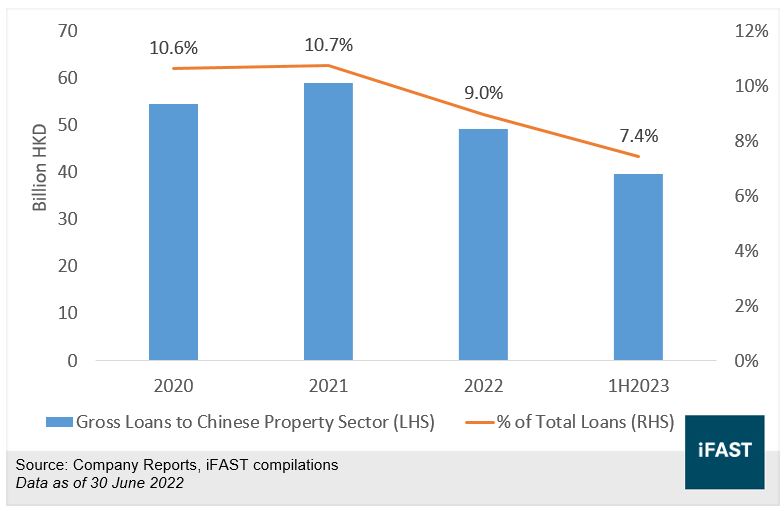 The increasing number of default cases
in the Chinese property sector uplifted the Non-Performing Loan (NPL) ratio
rose by 17 bps to 2.6% for BEA. In comparison to bank peers, BEA's NPL ratio of
2.6 is above the industry average and just marginally lower than that of
Standard Charted among mid-to-large banks.
It is important to take note that the NPL ratio is relatively subjective
indicator because each bank carries a different credit risk measurement model
and different definitions of NPLs. That said, the NPL ratio peer comparison is
not that indicative. For instance, Chinese banks are relatively conservative on
the definition of NPLs, with an average NPL ratio of 1.4% which is markedly
underestimated given the large exposure to the Chinese property sector.
The increasing number of default cases
in the Chinese property sector uplifted the Non-Performing Loan (NPL) ratio
rose by 17 bps to 2.6% for BEA. In comparison to bank peers, BEA's NPL ratio of
2.6 is above the industry average and just marginally lower than that of
Standard Charted among mid-to-large banks.
It is important to take note that the NPL ratio is relatively subjective
indicator because each bank carries a different credit risk measurement model
and different definitions of NPLs. That said, the NPL ratio peer comparison is
not that indicative. For instance, Chinese banks are relatively conservative on
the definition of NPLs, with an average NPL ratio of 1.4% which is markedly
underestimated given the large exposure to the Chinese property sector.
Furthermore, in spite of a rather high NPL ratio, BEA's credit impairment losses are not at a high level. The credit impairment losses in 1H2023 are even lower than those of 1H2020. We believe the rationale behind this unusual situation is owing to the high collateralization ratio of its loans to the Chinese property sector. In Short, BEA's lending to Chinese property developers is usually secured by collaterals, which could be liquidated to offset the potential credit loss in case of credit events.
Chart 3: NPL Ratio Comparison 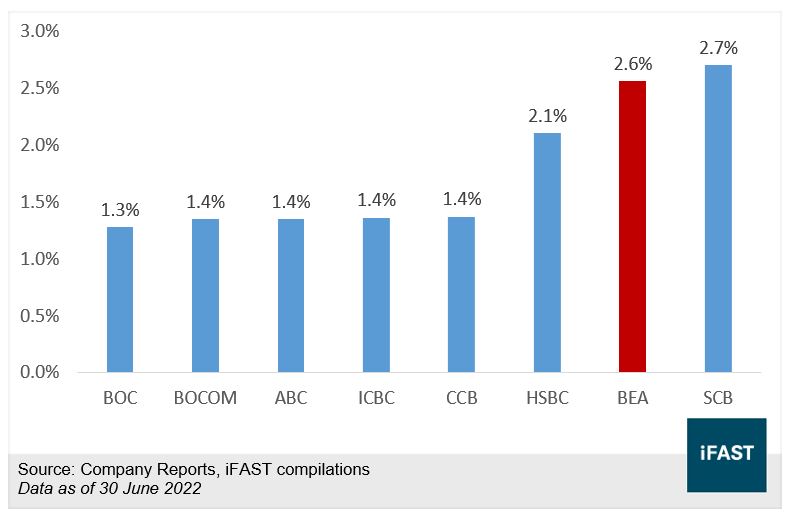 We also find that BEA is gradually altering the business structure
in China in response to the intensive credit risk of the Chinese property
sector, by reducing the lending to Chinese property developers. In the first
half of this year, the proportion of BEA's lending to Chinese property
developers dropped to 7.4%. Additionally, BEA places more emphasis on
non-interest income in China, such as investing banking and wealth management.
These actions are expected to remarkably reduce the NPLs. As a whole, we
believe the asset quality will improve and the NPL ratio trends downward following
the lower exposure to the Chinese property sector.
We also find that BEA is gradually altering the business structure
in China in response to the intensive credit risk of the Chinese property
sector, by reducing the lending to Chinese property developers. In the first
half of this year, the proportion of BEA's lending to Chinese property
developers dropped to 7.4%. Additionally, BEA places more emphasis on
non-interest income in China, such as investing banking and wealth management.
These actions are expected to remarkably reduce the NPLs. As a whole, we
believe the asset quality will improve and the NPL ratio trends downward following
the lower exposure to the Chinese property sector.
However, it's noteworthy that BEA's provision for bad debt seems to be pretty low. BEA's total NPLs (including asset classification in Substandard, Doubtful, and Loss) amounted to HKD 13.6 billion with a corresponding impairment provision of HKD 3.7 billion ending 30 June 2023, translating into a provision coverage ratio of 27.5%. Even though there is a regulatory requirement on provision coverage ratio in respect of Hong Kong's financial institutions, we believe BEA's impairment provision is not adequate in light of the fact that Chinese banks generally maintain a provision coverage ratio of over 150%. As a result, we believe BEA is motivated to increase the impairment provision moving forward, which may lead to a significant reduction in net profit.
BEA is Well Capitalized with Multiple Credit Indicators Among the Best in the Industry
In regard to indicators for measuring the credit risk of banks, capital adequacy is widely treated as the most important one. As of 30 June 2023, BEA's CET1 ratio stood at 16.8%, one of the highest levels in the industry and about 450 basis points above the regulatory requirement, as well as one of the best in the banking sector. It reflects that BEA is well capitalised with solid capability to withstand risk.
Chart
4: CET1 Ratio and Buffers Over Regulatory Requirement 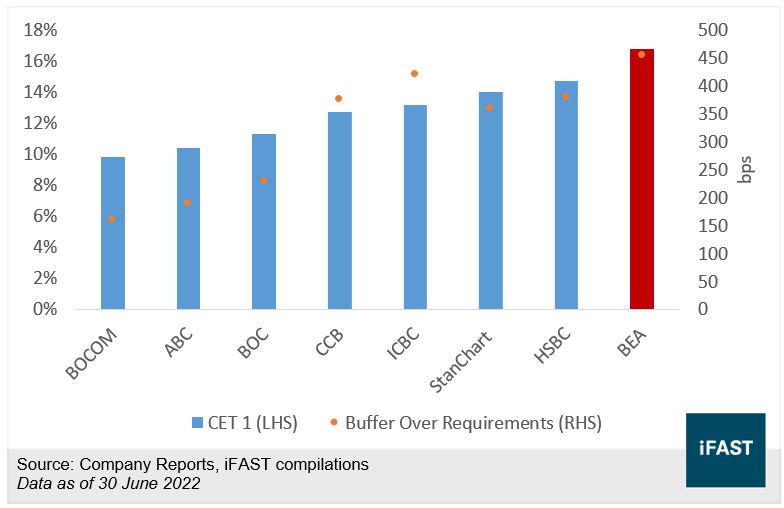 Leverage-wise, Under Basel III, a bank's leverage ratio is defined
as the ratio of Tier 1 capital to its total risk exposure. The chart below
depicts that BEA's leverage ratio remains over 10% for consecutive years, well
above the minimum regulatory requirement of 3%.
Leverage-wise, Under Basel III, a bank's leverage ratio is defined
as the ratio of Tier 1 capital to its total risk exposure. The chart below
depicts that BEA's leverage ratio remains over 10% for consecutive years, well
above the minimum regulatory requirement of 3%.
Chart 5: BEA’s Leverage Ratio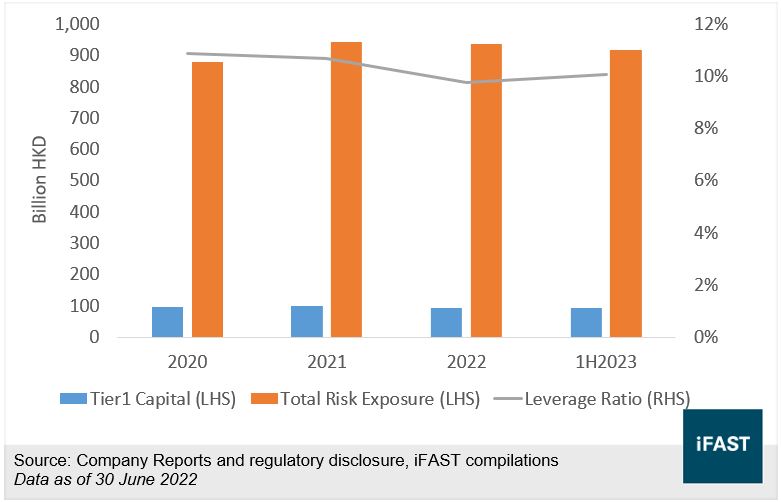 Moreover, BEA is not a member of Global
systemically important banks (G-SIBs), but it's subject to Financial
Institutions (Resolution) (Loss-absorbing Capacity Requirements—Banking Sector)
Rules in Hong Kong from 2020, which means that BEA will also need to meet the
requirements of the Total Loss-Absorbing Capacity (TLAC), besides the
requirement of Basel capital adequacy. TLAC can be interpreted as the sum of
the various types of equity and debt instruments that can absorb bank losses by
way of write-downs or conversions when a bank enters into a disposition
process. The minimum regulatory requirement on TLAC risk-weighted ratio
(defined as total TLAC to risk-weighted asset) and TLAC leverage ratio are 16%
and 6%, respectively. BEA's numbers on these indicators were 22.6% and 12.1%
ending 30 June 2023 (Chart 6), both well above the regulatory requirements.
Moreover, BEA is not a member of Global
systemically important banks (G-SIBs), but it's subject to Financial
Institutions (Resolution) (Loss-absorbing Capacity Requirements—Banking Sector)
Rules in Hong Kong from 2020, which means that BEA will also need to meet the
requirements of the Total Loss-Absorbing Capacity (TLAC), besides the
requirement of Basel capital adequacy. TLAC can be interpreted as the sum of
the various types of equity and debt instruments that can absorb bank losses by
way of write-downs or conversions when a bank enters into a disposition
process. The minimum regulatory requirement on TLAC risk-weighted ratio
(defined as total TLAC to risk-weighted asset) and TLAC leverage ratio are 16%
and 6%, respectively. BEA's numbers on these indicators were 22.6% and 12.1%
ending 30 June 2023 (Chart 6), both well above the regulatory requirements.
Chart 6: BEA’s TLAC Risk-weighted Ratio and Leverage Ratio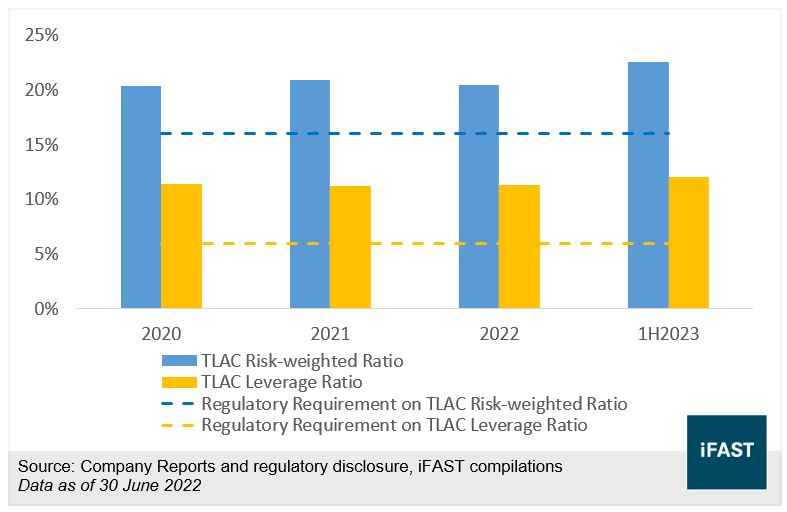 In
terms of liquidity, as of 30 June 2023, BEA's Liquidity Coverage Ratio (LCR)
and Net Stable Funding Ratio (NSFR) were 208.9% and 120.2% respectively, both
of which met the regulatory requirement of 100%, representing a solid liquidity
profile.
In
terms of liquidity, as of 30 June 2023, BEA's Liquidity Coverage Ratio (LCR)
and Net Stable Funding Ratio (NSFR) were 208.9% and 120.2% respectively, both
of which met the regulatory requirement of 100%, representing a solid liquidity
profile.
Table 2: BEA’s Liquidity Indicator
|
2021 |
2022 |
1H2023 |
|
|
Liquidity Coverage Ratio |
182.4% |
197.7% |
208.9% |
|
Net Stable Funding Ratio |
115.6% |
116.0% |
120.2% |
|
Source: Company Report, iFAST Compilations Data as of 30 June 2023 |
|||
All in all, BEA is well-capitalised with multiple credit indicators among the best in the industry. In view of the fact that the bank is in the process of reducing exposure to the Chinese property sector, the improvement in asset quality is expected to further enhance its risk resistance, and the overall credit profile is favorable.
Priority to be Given to 2027 Senior Unsecured Bond; Investors with High Risk Tolerance Can Consider the Tier 2 Bond
BEA currently has a large number of outstanding bonds, with seniority ranging from AT1 to senior unsecured. The Credit Suisse crisis in March this year resulted in a write-off of all AT1 capital and a complete loss for AT1 investors, indicating a high investment risk of AT1. As such, BEA's AT1 bonds are assigned with a credit rating of BB from S&P, whereas its senior unsecured bonds are rated BBB (S&P), representing a lower investment risk. Investors interested in BEA could give priority to senior unsecured bonds, such as bond due in 2027, which is currently yielding 7.1%, a relatively high level of returns amongst the bank bonds, making it an attractive choice.
In addition, considering the fact that BEA is well-capitalized with stable operation, the possibility of triggering a write-down to absorb loss is very unlikely, not to mention the fact that Tier 2 has a higher seniority over Tier 1 capital. We thus believe that the difference in investment risk between Tier 2 and senior unsecured bonds is modest. Currently, the yield to maturity of BNKEA 4.000% 29May2030 Corp (USD) is around 8.1%, much higher than the senior unsecured ones. From the angle of investment risk and potential return, we think investors with higher risk tolerance may wish to look at its Tier 2 bonds.
Table 3: Bonds Issued by BEA
|
Bond |
Seniority |
Outstanding Amount (Million USD) |
Credit Rating (S&P) |
YTM/YTW |
|
BNKEA 5.875% Perpetual Corp (USD) |
AT1 |
650 |
BB |
8.9% |
|
BNKEA 5.825% Perpetual Corp (USD) |
AT1 |
650 |
BB |
10.6% |
|
BNKEA 4.000% 29May2030 Corp (USD) |
T2 |
600 |
BBB- |
8.1% |
|
BNKEA 4.875% 22Apr2032 Corp (USD) |
T2 |
500 |
BBB- |
7.6% |
|
BNKEA 5.125% 07Jul2028 Corp (USD) |
Senior Unsecured |
250 |
BBB |
6.7% |
|
BNKEA 6.750% 15Mar2027 Corp (USD) |
Senior Unsecured |
500 |
BBB |
7.1% |
|
Source: Bondsupermart and BEA's regulatory disclosures, Data as of 23 November 2023 |
||||
Corporate Risk
Investors should be mindful of the following risks. Firstly, even though BEA lowered its exposure to the Chinese property sector, default risk might emerge from sectors other than Chinese property due to slower economic growth, which would further uplift the NPL ratio and weaken the asset quality as a result.
Secondly, all bonds issued by BEA (including senior unsecured) are embedded with the TLAC feature, which may result in a full or partial loss under some situations.
Conclusion
Bank of East Asia relied on interest income which could be able to benefit from the interest-hike cycle, with net interest margin climbing from 1.4% in 1H2022 to 2.0% in 2H2023. Given that the interest rates for HK/US are expected to remain higher for longer, we believe the Bank of East Asia could continue to benefit from the rising-rates environment to further improve profitability.
In terms of credit quality, the CET1 ratio stood at 16.8% ending on 30 June 2023, which is well above the regulatory requirement and one of the highest levels in the banking segment. The bank's exposure to Chinese property developers was pretty significant for a long time, but with the ongoing reduction in loans, asset quality is expected to improve and the overall credit profile remains excellent.
Investors may give priority to senior unsecured bonds, with a yield to maturity of nearly 7% for the 2027 USD bond, which is attractive among bank bonds. Investors with higher risk tolerance may also consider its Tier 2 bonds for yield pickup but should be aware of the associated investment risks.
Declaration: For specific disclosure, at the time of publication of this report, IFPL (via its connected and associated entities) and the analyst who produced this report hold a NIL position in the abovementioned securities.
Our podcast series, Yield Hunters, is available on Spotify, iTunes Podcasts and Google Podcasts. We share our thoughts on new bond issues and hold discussions on the fixed income space. Listen to our latest episode below and follow us!